Loading journal
Articles
The metamorphosis of the book and its designer
Fabio Mario Rizzotti
3 November 2026
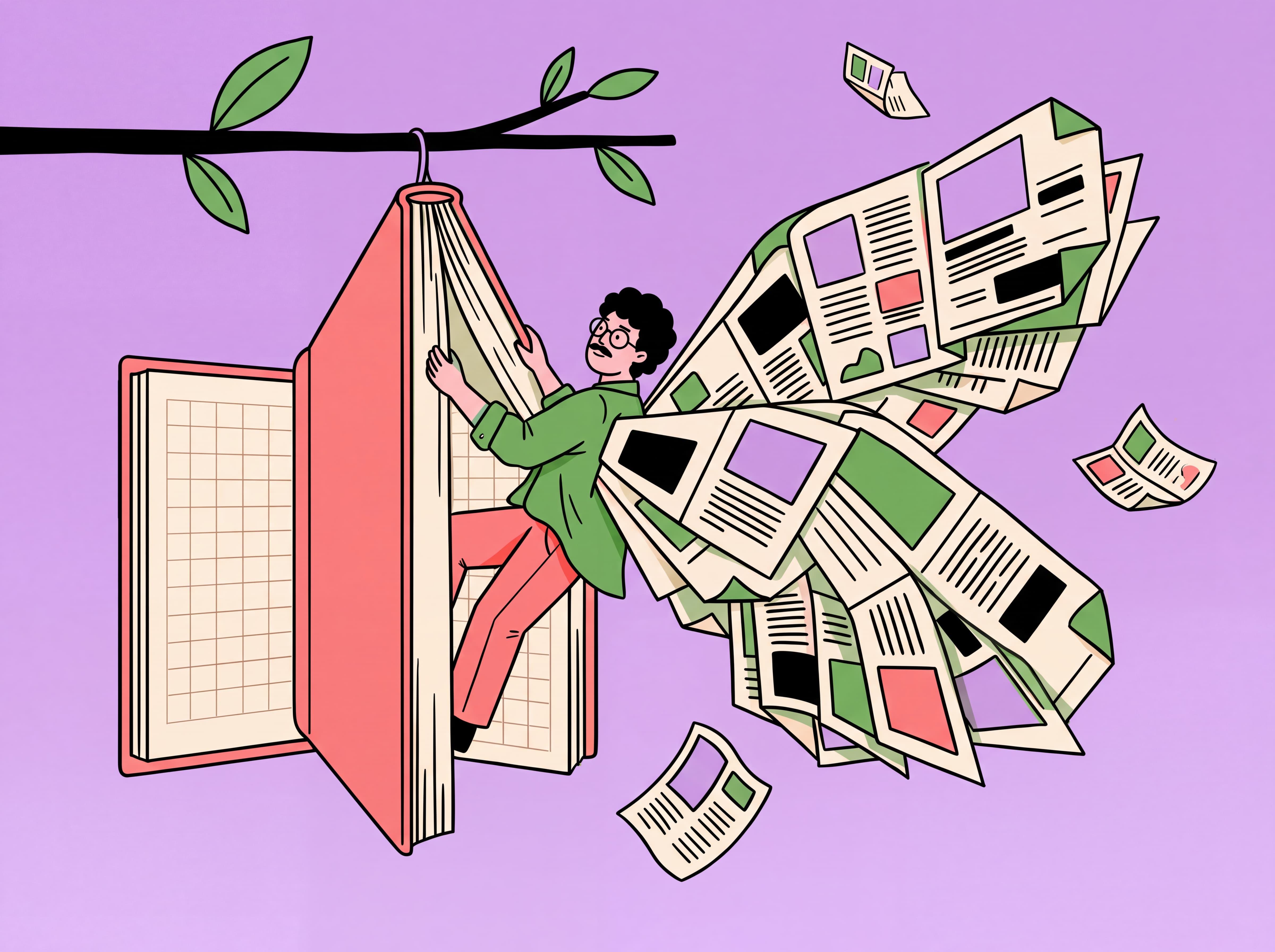
Metamorphosis signals a profound process of transformation — and no word better describes what publishing is going through today, but above all what is happening to the role of the young designer.
Designing a book is now an infinitesimal part of being a designer, something rare at a professional level, however much it remains sought after. And yet the vast majority of projects submitted to Pittogramma are editorial in nature. Even those who design a wayfinding system for their thesis end up sending the documentation of the usage manual in editorial form. It is something that has always struck us, and it says a great deal about how the book remains a point of reference for those learning this craft — not so much as a final product, but as a structure of thought. The book is the form through which one learns to combine text and images, to build a hierarchy, to give rhythm to content.
The greatest mistake, however, would be to confine this value to designers alone. The book is, by its very history, something intrinsic to human evolution. Over the centuries this evolution — or rather, this metamorphosis — has unfolded through industrial and technological discoveries, but also through cultural necessity: the spread of the Bible, the birth of the printing press, mass publishing, the paperback. Each transformation redefined the medium without erasing it. This is why the book endures, and will always endure, as the most lasting container of our collective memory.
The problem is not saturation — it is conformity.
Today we live in an almost entirely digital era, and the book, this extraordinary object, continues to exist. The same is true of the young designer. Despite the revolution underway — first with the proliferation of branding as a dominant discipline, and now with artificial intelligence — the role of the designer has been profoundly reshaped. Where once there was a relatively linear path: intern, junior designer, mid and senior designer, art director — today that path has become atypical, to put it mildly. The great studios that once represented the natural destination of a career are fewer and fewer. Large agencies have adopted increasingly hybrid and flexible working methods, bringing in remote or freelance designers on a day rate. The boundary between employee and independent professional has grown thin, and with it, so has the distinction between training and work.
This is perhaps the most delicate point in the transition from education to professional life: schools still prepare students, largely, for a model the market has already moved beyond. This is not directly the fault of schools — it is the speed at which the industry transforms that makes any meaningful update to curricula so difficult. But the young designer cannot afford to wait. They face what appears to be a saturated landscape, which in reality has a growing hunger for new voices, fresh perspectives, stylistic approaches that do not simply replicate established canons. The problem is not saturation — it is conformity. Those who leave school convinced they must imitate the great masters risk arriving late to a conversation that has already moved on.
The young designer would do well to look to publishing — not to make books, but to learn how to transform.
The young designer must then undergo their own metamorphosis, just as the book has done every time the world around it changed. They must begin to believe in their own ideas before they even finish their studies, understanding that autonomy is not a luxury to be postponed but a skill to be built from the very beginning. Independent publishing, in this sense, offers a model: small projects, limited resources, great clarity of vision. Magazines, fanzines, self-produced publications that do not ask permission to exist, but find their own audience and build it over time. The young designer would do well to look to publishing — not to make books, but to learn how to transform, and to begin charting a path of their own.